I remembered a quote I read somewhere and I thought it was a simple trick to be productive while procrastinating. It also feels like something scanners love to do.
“I like to work on two tasks at the same time. So that I can procrastinate on one task by working on the other and vice versa.”
As a scanner, I have several ideas and may even get started on some of them only to abandon them. (Non-scanners will likely castigate this kind of behavior as having a lack of focus etc. But we know that scanners function differently).
Abandoning an idea and moving to a new one is not always an easy move. Sometimes, I wrestle with thoughts like “Am I missing out on an opportunity here by quitting early?”, “Did I really do my best in this endeavour?”, “Was it worth it?”, “Should I have stayed a bit longer to see if my results would be different?”, “Should I have forced myself to keep going so that people would know that I was truly dedicated?” Notice how this last thought especially is a complaint rooted in negative criticisms from others. Sometimes, these negative thoughts follow me to the new project I am now excited by.
Does any of this resonate with you? If yes, may I suggest a something to try? Ritualize your Exit. Practice graceful quitting and graceful exiting. Being a scanner that leaves one interest to pursue the next does not necessarily eradicate the possibility of feeling some grief. (Grief is a response to loss). Even when a scanner knows that they are done with a project, they may feel some loss and other emotions. When this happens, enacting a ritual of letting go can help to 1. counteract those negative voices from people who don’t understand how scanners work. 2. process your feelings of grief.
Being a scanner means that we are more likely to go through grief and feelings of loss more than others. This has been my experience. These feelings are normal and they need acknowledgement. A ritual of letting go helps to give these feelings a home so that we can feel more settled in our bodies and move on to the next exciting project.
Here is how to create a ritual:
These are some potential elements to include in your ritual: words, body gestures, symbolic objects/specific decorations, meditation. Using as many or as little of these elements will determine how elaborate your ritual is.
Once you’ve decided a date and time, here is an order of service you may use:
Opening ritual: Setting the physical location: set the candles, go to the park, get into your meditation pose, or, speak your opening words.
Set your intention/agenda: light the candles, meditate, or, speak the words that reminds you what you are here to do.
Reflections: share your thoughts on the project. This is an elaboration of what intention/agenda you set. Explore your feelings: the good bad and the ugly.
Ritualize the letting go: Blow off the candles (or not), release the balloon into the air, drop your sand into the ocean (or just back to the earth), burn your piece of paper (or just tear it up into pieces), or, mentally close the project.
Looking ahead to the future: remind yourself of what lies ahead.
Closing: blow off the candles (if they are not off already), pack up the physical location you used, get out of your meditation pose (or meditate again), start walking making your way back home from the park, or, say some closing words.
Here is what I have done in the past
My graceful quitting ritual is basically the same format.
I set time apart with myself to ritualize my graceful quit/exit from a project (You can include people but be sure that they are people you know can provide the emotional support you need)
I spend a few minutes listening to my body to learn how I feel about the past project.
I reflect on the past project and reminding myself of when and why I started the project, what I learned during the project, and how/when I knew it was time to stop.
I speak to myself sharing gratitude for my scanner mind, the resilience that I have despite negative voices, the opportunity to explore the project, for the people who gave me the opportunity and supported me. I thank God. I thank my body for all that it enables me to do. Then I speak to the project, thanking it for all the lessons I learned from it.
I speak to myself reminding myself that my time has I move on to a new project. I will not forget the lessons I learned from the last one. I shall move on with the joy and confidence that I deserve in my work. I may start from a new beginning but I bring along with me the wisdom and experience from past projects. I may need to learn new things but I bring with me knowledge, and greater self awareness and more exposure and age.
Closing the project: I physically close the word document, delete files, put them in an archive, tuck the book away somewhere, throw away or pack things away. I have also just mentally let go of the project.
One time when I was 5 someone asked me what I wanted to be when I grew up. I said, “I want to be an astronaut.” One hour later, I decided that I wanted to be a businesswoman. Then later I said I was going to be a teacher. Fast forward to age 14, someone asked me what I wanted to be. I said I wasn’t sure but I knew I wanted to learn shoe-making, hair making, and tailoring. Then at age 19, I wanted to be a farmer, teach at a university, and then have a non-profit organization all at the same time. I cannot tell you how many times I heard, “You need to focus”, “Just pick one and focus” and “Don’t be a Jack of all trades!” Perhaps, you know people like that in your life.
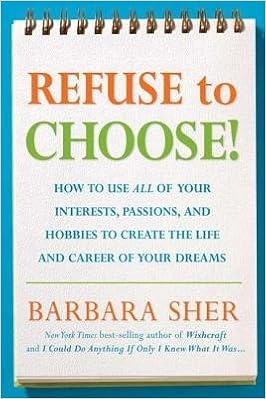
Image description: Book Cover page titled: Refuse to Choose: How to use all of your interests, passions, and hobbies to create the life and career of your dreams. By Barbara Sher.
None of those interests was wishful thinking. I did have a small farm while I was studying and researching how to start a non-profit. I bought the shoe-making course and had a doll to practice hair-making with. Nonetheless, I needed to google things like “how can I live multiple lives?” and “what kind of jobs are good for people with multiple interests” and even “would I ever like my job?” Then I came across Barabar Sher’s book, Refuse to Choose. From thence came my revelation. There are people with multiple and seemingly dissimilar interests that can often change. Barbara Sher calls it a scanner personality. A more familiar term might be the “renaissance man.” (Think: Da Vinci who was a painter, scientist, sculptor, engineer, architect…Galileo who was an astronomer, physicist, engineer, natural philosopher, mathematician… more recently, Warren Buffet who owns 60 companies from restaurant chains to investment agencies.)
The imagery I love that Sher uses is the honey bee. When bees go looking for flowers to suck from, they may spend 2 seconds or 20 seconds on a flower before moving on to the next. We do not say that the bee lacks focus. The bee is simply done with the flower and moves on when that flower no longer serves its needs. The bee may even return to a previous flower if its needs have changed. For scanners, it is similar, what others may call a lack of focus, scanners, they (need to) move on when an interest no longer serves them.
The rewards that a scanner may look for are several. No, money is not one of them. Scanners may desire the rewarding feeling that comes from sharing knowledge or skills with others, learning how things work, being competent enough to “save the day” when others don’t know what to do, creating beauty all around, and so on. Several interests are necessary to provide these rewards such that telling a scanner to choose is equivalent to telling a fish not to live in water.
Rather than making a scanner choose and make a career out of one thing, Sher offers tools and life design models that helps scanners make a career and life around all their interests that serves the scanner’s needs. My favourite tool is the Big Calender. It sounds simple, right? But take together the fact that with so many interests scanners can easily feel immobilized that there is not enough time for everything. A calendar especially when publicly displayed provides assurance that there is enough time to do everything.
I could write so much more on this topic. But I think this is enough for now. I have refused to choose and here is my blog about all the several things I’d ever blog about.
Would you like to know what else I’m interested in? Check out my impossible list, here.
 Everything Shola